 |
 |
 |
|
||||||||||
 |
 |
 |
 |
 |
 |
 |
|
|
|||||
 |
|
|
|||||||||||
 |
 |
|
|
||||||||||
 |
|
||||||||||||
| |
|
||||||||||||
| |
|
|
|
|
|
|
|
|
|
|
|
|
|
| |
|
|
|
||||||||||
| |
|
|
|
|
|
|
|
|
|||||
| |
|
|
|||||||||||
| |
|
|
|
||||||||||
| |
|
||||||||||||
| |
|
||||||||||||
| |
|
|
|
|
|
|
|
|
|
|
|
|
|
SONA PUJARI - STREET BANKER
Now, Sona's been
expecting me and Rashida for the past half-hour. Because at ten sharp she
wants to go to work. Sona's cooking Pohar, flaked rice mixed with onion, ground
nut, all soaked in water and then fried to make a simple mid-morning snack.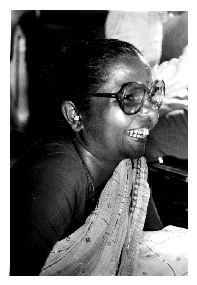
Now, Sona's hut is probably the smallest on 14th Gulli. Eight by five, made
of bamboo and plastic sheeting, with a curb stone to anchor the rear wall.
As neat as could be. Important papers and Sona's spare saris are stuffed under
the bamboo eaves.
In the corner, in the place of honor, sits the Goddess Yellama, made of twisted
tin and clothed with great care in gold, green and red silks.
Tuesdays and Thursdays, Sona carries Yellama round Bombay Central and quite
literally begs for her supper. But this morning she's about to don her other
hat - that of Mahila Milan Street Banker, and go off up the lane in search
of a rather different sort of customer.
Sometimes, as in this instance, the customer gets to the bank before the bank
gets to the customer.
Sona takes Padmabi's passbook from a pile on her cot, stuffs the ten rupee
banknote inside, and returns to stirring the Pohar. .
“Needs another thirty minutes.”
Sona places a thali over the skillet. Uncrosses her legs, adjusts her sari,
and stuffs the passbooks into a plastic bag.
“Come on. Chello. We've got time! Let's go and collect money!"
Fifty of the women here on the Gulli are members of Mahila Milan. Most of
them have two types of bank accounts: a Crisis Savings account for emergencies.
Where they get no interest and they pay no interest. They just have to pay
back the loan at an agreed pace.
And then there are Housing accounts: the down payment on their eventual homes
- their real pucca homes, one day, somewhere in the city.
Sundra Ramu slips her ten rupees, her regular repayment for a loan.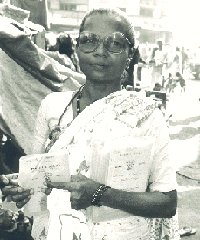
The next woman asks to put off paying Sona till this evening. Now, simply
is not the right time!
“I asked her for money, for her savings. But she is saying that in my
soul some Goddess has come, so I give you afterwards.”
Poor Harabhai! Sona is nothing if not direct in her approach: “Harabhai,
Give!:
And then the money starts to come in, in dribs and drabs. But it's a steady
stream that all adds up. Some for the Housing account, most of it to replenish
their crisis savings, run down for a multitude of reasons.
Sujahari says she's broke today. Sona just stands there. The woman reluctantly
produces a couple of coins from the folds of her sari. So five rupees from
Sujahari, two rupees from Nimbewa, some into the Housing account, but most
into Crisis Savings
Some of Sona's customers are familiar faces from less happy times, when Sona
was herself forced to work as a prostitute on this very same street.
Most of the deposits today are small amounts they pay in every day - two,
five, ten Rupees maximum, from a daily household income that can vary anywhere
between twenty to sixty Rupees on upwards.
Just occasionally, you get an exception, such as Suresh Gaidkarke who pulls
five crisp ten Rupee notes from her choli and hands them to Sona. That's fifty
Rupees - a full day's wages! Sona pulls out the passbooks, looking for the
right one.
How come? That's a large amount at one go.
Turns out Yellubi became a mother a couple of months back.
“She had a baby.” Explains Sona, “So, one month she didn't
give. Today she is giving 50 Rupees.”
I ask Suresh Gaidkarke if she prefers to give large amounts every month rather
than small amounts daily: “I prefer to give smaller amounts every day
because it's easier. But it’s really problem for me to save during the
monsoon months.”
She needed to withdraw from her Crisis savings to pay for the expenses of
the baby Now, she’s starting to build them back up. Her husband works
as a docker. But having the baby means just the one income. So anything she
can put away now may come in very useful in the not-too-distant future.
Sona continues her way slowly up the gulli, stopping to chat with everybody
- the prostitutes on the left-hand side, the pavement dwellers on the right.
Everyone hands over something. It's like making an offering to the goddess
Yellama.
“Sona, you are quite simply the best money collector I've ever seen!”
I spontaneously exclaim.
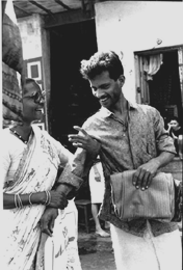 “
Don't praise me so much. Otherwise I'll be flying in the sky!” But Sona
is absolutely beaming!
“
Don't praise me so much. Otherwise I'll be flying in the sky!” But Sona
is absolutely beaming!
I often think the residents on Fourteenth Gully give to Sona as they would
make offerings at a temple, to propitiate the gods, bring them good fortune.
Sona isn't casual about making people learn to save either. She just stands
there until you can bear it no longer, and you start to scratch among your
clothes and somewhere find a rumpled note - two, five, ten - it's not important.
I sometimes kid Sona that she's really an extortionist, forcing people to
save when they don't really want to. Sona plays dumb if I suggest this. Without
saying a word, she encourages me to verify with any of her customers.
I pick on Jyoti because last week Jyoti told Sona to her face she had no money,
and Sona still came away with two Rupees in Jyoti's savings book. Jyoti is
quite forthcoming when Sona plonks herself down, all four foot six of her,
in front of Jyoti who's washing beans.
"She does everyday. She comes even when I don't have any money. If I
say I'm broke she does go away. But then she comes back the next day, maybe
later that same day. Then, I have to give her something. Not because she forces
me. But I have to give something to her, because she is the person who helps
us to get the loan. That's why we feel like to give her even though we don't
have. We get it from somewhere and give it to her. She doesn't leave us till
we give her.
Poor Raju! He's not so lucky.
Raju's a few minutes late getting off to work. Sona sees him, stops, looks
hard at hime, impassively, then nudges her eyelids.
Raju looks at Sona, reluctantly reaches into his trouser pocket, pulls out
two ten Rupee notes, hands them to Sona and exits the lane fast.
Sona says that's not extortion, merely "Forced Savings."
On a typical morning, Sona will collect four hundred Rupees from the street
($8). And she admits she enjoys collecting money. Sona does this work for
nothing. It's never entered her head to expect to be paid for it. It's her
way of being useful. Her duty, her dharma.
One day, her customers will get the rewards. .
Some of the prostitutes on 13th and 14th Gulli now save with Sona.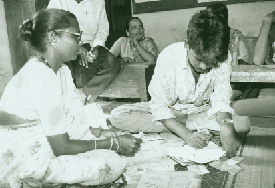
“Hey, Rukma!” Sona bellows like a foghorn.
Sona plants herself on the doorstep of one of the brothels. She's looking
for two of her regulars - Rukmani and Basava. Basava saves 3o Rs every day
and Rukmani saves 10 rs every day. But both of them have gone to bazaar to
buy vegetables. They are not here.
Basava has taken out large loans before. Once, she borrowed 5,000 Rupees to
buy land back in her village. Now she wants to borrow 3,000 Rupees to celebrate
her daughter's first child. A lot of money. But then Basava can earn fifty,
up to a hundred a day, doing the cleaning in four brothels here on 13th Gulli.
In fact, Sona's opened Crisis Savings accounts for at least twenty of the
prostitutes here..
“Before making them Mahila Milan members I had a meeting with other
Mahila Milan leaders and informed them that there are these prostitute womens,
and they want to open Mahila Milan account. So, are you ready to accept them?
They said: OK. It's a good thing if they want to improve their life, they
want to save for their future.
Of course, most of the girls are already hopelessly in debt to a combination
of pimps, ghawalis and moneylenders and will probably never get out. But Sona
says saving with Mahila Milan has enabled maybe four or five to pay off their
debts and move completely out of the business, much like Sona once did, fifteen
years ago.
Basava's back. Sona's telling her the bank will loan her 1,000, not the 3,000
she's asking. Basava isn't arguing. She knows she's got a good deal at 12%
per annum.
The moneylender would also charge her 12 percent. But 12 percent, a month!
Sona's spotted Raju. She stops. Raju looks at Sona. Then at me. He reluctantly
reaches in to his pockets.
“Raju, saving 20 Rupees.” explains Sona. To me it looks more like
extortion!
So, that's Banking's finished for the morning. Time to get back to her hut
and sit and sample pohar. Maybe time to to chat about something other than
money.
But in the corner of the hut, the Goddess Yellama is watching over our meal.
I know exactly what I now have to do! Find a clean 50 Rupee note.
And hand it to Sona!
“This is for Yellama!”
Sona delicately folds the note and places it in Yellama's lap.
With most pavement dwellers a foreigner probably always remains just that,
a foreigner. But with Sona, after a rocky beginning, a real friendship has
developed. She's been trying to improve my Hindi, so we can have real conversations
together. Sona wants me to go with her to Punam, a big festival in her native
Karnataka. I can't go this year. But, one day, if the invitation still stands,
I probably will.
Essay
Episodes 1 - 4
Episodes 5 - 8
Episodes 9 - 12
Episodes 13 - 16
Episodes 17 - 20
Episodes 21 - 24
Episodes 25 - 28
Episodes 29 - 32
Episodes 33 - 35
Main
Episode List
Cast of Characters
Credits
© 2002,
Independent Broadcasting Associates, Inc
Privacy Policy |
Terms of Use